 Spot Startups
10 Best Startup, SaaS & AI Tool Directories to Submit Your Product in 2026

Launching a startup is easier than getting people to discover it.
You can spend weeks building a SaaS product, AI tool or web app, publish your website, and still have very few people visiting it. For a new startup, the first challenge is often not the product itself — it is getting the product in front of the right people.
This is where startup directories, SaaS directories and AI tool directories can help.
Product directories give founders another place to introduce their products, reach potential users, collect feedback and build awareness. Some are designed for product launches, while others focus on software reviews, alternatives, AI tools or early-stage startups.
But not every directory is equally useful for a brand-new startup.
A founder launching their first SaaS product has different needs from an established software company with thousands of customers and hundreds of reviews.
In this guide, we'll look at 10 startup, SaaS and AI tool directories worth considering in 2026, what each platform offers, its advantages and disadvantages for a new startup, and when it makes sense to submit your product.
What Is a Startup Directory?
A startup directory is a website where founders can list their startups, products or companies so that people can discover them.
Depending on the platform, a listing may include:
- Product name and description
- Website link
- Product screenshots
- Features
- Categories
- Pricing information
- Reviews or ratings
- Founder information
- Product updates
- Community discussions
For a new startup, this can create an additional discovery path beyond Google Search and social media.
Some directories are general startup platforms, while others specialize in SaaS products, AI tools, software, apps or business technology.
Why Should a New Startup Submit to Product Directories?
Imagine that you have just launched a small SaaS product.
Nobody knows your brand yet. You don't have thousands of followers, your website has very few backlinks, and you haven't collected many customer reviews.
Waiting for organic traffic alone can take time.
Submitting your product to relevant directories gives you additional places where potential users can discover it.
A directory listing can potentially help with:
Product discovery: People browsing a category can discover your product.
Referral traffic: Interested visitors can click through to your website.
Brand awareness: Your startup name can appear in more places across the web.
Feedback: Some communities allow users to comment, vote or review products.
Launch exposure: Launch-focused platforms can help introduce a new product to an existing audience.
However, directory submission isn't a magic SEO shortcut. A listing does not guarantee traffic, customers or higher Google rankings. The value depends on the platform, your product, your audience and how actively you promote the listing.
1. SpotStartups
If you're launching a startup and looking for a straightforward place to introduce your product, SpotStartups is built specifically around startup and product discovery.
SpotStartups allows founders to submit startups, SaaS products, AI tools, web apps and other online products and create a public product listing.
The platform publishes 10 new products every day, giving newly submitted products an opportunity to appear among recently launched products.
What can you do on SpotStartups?
A product listing can include your product information, category and website, helping visitors understand what your product does before visiting your site.
SpotStartups also includes features such as:
- Free product submission
- Product discovery pages
- Startup and product categories
- Community voting
- New product launches
- AI and SaaS categories
- Product backlinks
- Daily product publishing
- Product discovery by category
- Growth Gap Report for deeper product analysis
The Growth Gap Report is particularly different from a basic directory listing. It provides additional analysis around areas such as onboarding, functionality, mobile experience, trust signals and findability.
Why it can be useful for a new startup
The biggest advantage for an early-stage founder is that you don't need to wait until your company has hundreds of customers.
You can submit a working product, create a public listing and start building another discovery channel while you continue working on the product.
For founders looking for a Product Hunt alternative, it can also provide another place to showcase a new product, especially if you're not ready for a major launch campaign or don't yet have a large audience.
It can also be useful as an early step before submitting to larger platforms.
What are the disadvantages?
A directory listing shouldn't be treated as a guaranteed source of customers.
Your results can depend on how interesting your product is, how much community activity it receives and whether you promote the listing yourself.
The free listing also doesn't replace your own marketing, SEO or distribution strategy.
Best suited for: New startups, SaaS products, AI tools, indie products and web apps.
Submission: Free submission available.
2. Product Hunt
Once your product is ready for a public launch, Product Hunt is one of the platforms many technology founders consider.
Unlike a conventional business directory, Product Hunt is heavily focused on product launches and community discovery.
A launch gives you a dedicated product page where people can learn about your product, interact with the launch and discuss it with the maker.
Features
Product Hunt offers:
- Product launches
- Maker profiles
- Product pages
- Community discussions
- Comments
- Upvotes
- Product categories
- Launch scheduling
Product Hunt currently allows makers to submit their own products through a personal account.
Advantages for a new startup
The biggest benefit is the launch-oriented audience.
Instead of quietly adding your startup to a directory, you can create a specific moment around your product launch.
Community feedback can also be useful when you're still improving the product.
Disadvantages
A Product Hunt launch requires preparation.
You'll need a strong product page, screenshots, description and launch messaging. You also shouldn't assume that simply publishing a launch will generate significant traffic.
The attention around a launch can also be relatively short-lived, so founders should have a plan for what happens after launch day.
Best suited for: Startups launching a new SaaS, AI tool, app or technology product.
3. SaaSHub
If your product is a SaaS application, SaaSHub takes a different approach from launch-focused platforms.
It is primarily a software discovery and alternatives platform, making it useful for people researching different software products.
SaaSHub allows eligible products to be submitted through its submission system and states that product submission is free.
Features
- SaaS listings
- Software categories
- Product alternatives
- Competitor discovery
- Product profiles
- Software comparisons
- Startup discovery
Advantages for a new startup
A new SaaS product can benefit from being present where people are already looking for software.
The alternatives aspect can also be useful if your product solves a problem that established competitors already address.
Disadvantages
SaaSHub isn't primarily a launch-day community.
Your product also needs to meet its submission requirements, and simply creating a listing doesn't guarantee substantial traffic.
Best suited for: SaaS companies, software products, web apps and online services.
4. G2
G2 is a different type of platform altogether.
Instead of primarily focusing on startup launches, G2 is heavily focused on software reviews and buyer research.
For a new B2B SaaS company, that distinction matters.
If you've just launched an MVP with no customers, a review marketplace may not be your first priority. But once businesses are actively using your software, review platforms can become much more relevant.
Features
G2 provides:
- Software profiles
- Customer reviews
- Product categories
- Comparisons
- Buyer research
- Vendor profiles
- Software reports
G2's current documentation says products go through eligibility and categorization processes, and it states that B2C products and alpha/beta products aren't accepted through its product-listing process.
Advantages for a startup
For B2B software, customer reviews can become an important part of the buying process.
A company researching several products can compare software and read experiences from existing users.
Disadvantages
This is less useful for a startup that has no customers yet.
It is also not designed for every type of product. The eligibility requirements mean some early-stage or consumer products won't fit.
Best suited for: Established or growing B2B SaaS and business software.
5. Capterra
Capterra is another major software discovery platform, but its audience is different from a startup launch community.
Businesses use software directories such as Capterra to research and compare software for specific business requirements.
Features
Capterra includes:
- Software categories
- Product profiles
- Reviews
- Software comparisons
- Vendor information
- Buyer research
Advantages for a new startup
For a B2B SaaS company, being present where businesses research software can eventually become valuable.
The category structure also allows products to be discovered based on the type of software they provide.
Disadvantages
A very early startup may not get the same value from Capterra as a company that already has customers and a mature product.
It is also more focused on software purchasing than startup launches.
Best suited for: B2B SaaS and business software companies.
6. AlternativeTo
What if your product isn't completely new to a category, but is an alternative to an existing product?
That's where AlternativeTo becomes interesting.
AlternativeTo is designed around finding alternatives to software and online services.
Features
- Software profiles
- Alternative recommendations
- Categories
- User contributions
- Ratings/voting
- Platform information
- Comments
Advantages for a new startup
Suppose you've built a new project-management application.
People already searching for alternatives to existing project-management tools may be interested in your product.
That makes alternative-focused discovery particularly relevant to startups entering an established category.
Disadvantages
Your product needs to fit naturally into an existing software category.
It's also not primarily a launch platform, so don't expect the same type of launch-day attention you might seek from Product Hunt.
Best suited for: Software products competing with established applications.
7. Futurepedia
For an AI startup, general startup directories are only part of the picture.
AI-specific directories can provide another discovery channel because users visit them specifically to find AI products.
Futurepedia focuses on AI tools and AI-powered software.
Features
- AI tool discovery
- AI categories
- Tool profiles
- AI use cases
- AI software discovery
Advantages for a new AI startup
The audience is already interested in AI tools.
That can make a specialized AI directory more relevant than a general startup directory when your product has a clear AI use case.
Disadvantages
The platform is primarily relevant to AI products.
The AI-tool market is also crowded, so simply appearing in an AI directory doesn't automatically make your product stand out.
Best suited for: AI tools and AI-powered applications.
8. There's An AI For That
Another AI-specific discovery platform is There's An AI For That.
Its approach is centered around helping users find AI tools for particular tasks.
This can be particularly useful if your product solves one clearly defined problem.
Features
- AI tool discovery
- Task-based discovery
- AI categories
- AI product listings
- AI use cases
Advantages for a new startup
Task-based discovery can be useful for AI products with a very specific value proposition.
For example, an AI tool designed specifically for meeting summaries can be positioned around that particular task rather than trying to compete as a generic "AI assistant."
Disadvantages
Again, the product needs to be clearly relevant to an AI use case.
Popular AI categories can also contain many competing tools, so positioning and differentiation remain important.
Best suited for: AI startups with a clearly defined use case.
9. BetaList
Not every founder is launching a mature product.
Some are launching an MVP, private beta or early-stage startup and primarily want to reach early adopters.
That's where startup-focused platforms such as BetaList can be relevant.
Features
- Early-stage startup discovery
- Startup profiles
- Product discovery
- Founder/startup audience
- New startup exposure
Advantages for a new startup
The early-stage focus can make it more appropriate for a young startup than software-review platforms aimed at established vendors.
It can also be useful for founders looking for people interested in trying new products.
Disadvantages
Early-stage exposure doesn't automatically translate into customers.
Founders should also check the platform's current eligibility rules before submitting because requirements can change.
Best suited for: Early-stage startups and new products.
10. Uneed
The final platform in this list is Uneed, a product discovery platform that is particularly relevant to indie makers, SaaS founders and people launching new online products.
Features
- Product launches
- Product discovery
- Product categories
- Community interaction
- Startup and indie-product discovery
Advantages for a new startup
Uneed can give a small product another launch channel without relying entirely on the largest platforms.
This can be particularly useful for indie founders and micro-SaaS builders who want to test several distribution channels.
Disadvantages
It shouldn't be treated as a replacement for your own marketing.
Traffic and engagement can vary depending on the product category and how actively you promote your listing.
Best suited for: Indie makers, micro-SaaS, AI tools and early-stage products.
How These 10 Directories Are Different
The important thing for a new founder is that these platforms aren't actually competing for exactly the same purpose.
| Directory | Main purpose | Useful stage |
|---|---|---|
| SpotStartups | Startup & product discovery | New/early |
| Product Hunt | Product launches | Launch |
| SaaSHub | SaaS/software discovery | Live product |
| G2 | Software reviews | Growing B2B SaaS |
| Capterra | Software research | B2B SaaS |
| AlternativeTo | Software alternatives | Established category |
| Futurepedia | AI tool discovery | AI products |
| There's An AI For That | AI task discovery | AI products |
| BetaList | Early startup discovery | Early stage |
| Uneed | Product launches/discovery | Indie/early |
Where Should a New Startup Start?
You don't need to submit your startup to all 10 websites on the same day.
Instead, think about what you're trying to accomplish.
If you've just launched a new product, startup and launch platforms can be a logical starting point.
If you've built a SaaS product, software discovery platforms become more relevant.
If you've built an AI tool, add AI-focused directories to your submission plan.
If you already have customers and reviews, software review platforms become more relevant.
The key is matching the directory to your current stage rather than simply trying to collect as many listings as possible.
How to Prepare Your Startup Before Submission
Before submitting your product, prepare a simple startup profile that you can customize for different platforms.
You'll usually want:
- Product name
- One-line tagline
- Short description
- Detailed description
- Logo
- Screenshots
- Product URL
- Main features
- Pricing
- Target audience
- Main use cases
- Social media links
- Founder information
- Demo video, if available
Don't copy the exact same description everywhere.
A launch platform, SaaS directory and AI directory have different audiences. Adjust your description so that the most important information for that platform appears first.
Does Submitting to Startup Directories Help SEO?
Startup directory submissions can create additional online discovery opportunities, but they should not be viewed as a guaranteed SEO technique.
Google rankings depend on many factors, including the relevance and quality of your content, technical website quality, authority, links, user experience and competition for the search query.
A directory can still be useful because it can provide:
- Referral traffic
- Brand discovery
- Product mentions
- Additional pages describing your company
- Potential relationships with customers and communities
The better strategy is to combine directory submissions with content marketing, technical SEO, product-led growth, social distribution and customer acquisition.
What About AI Search and GEO?
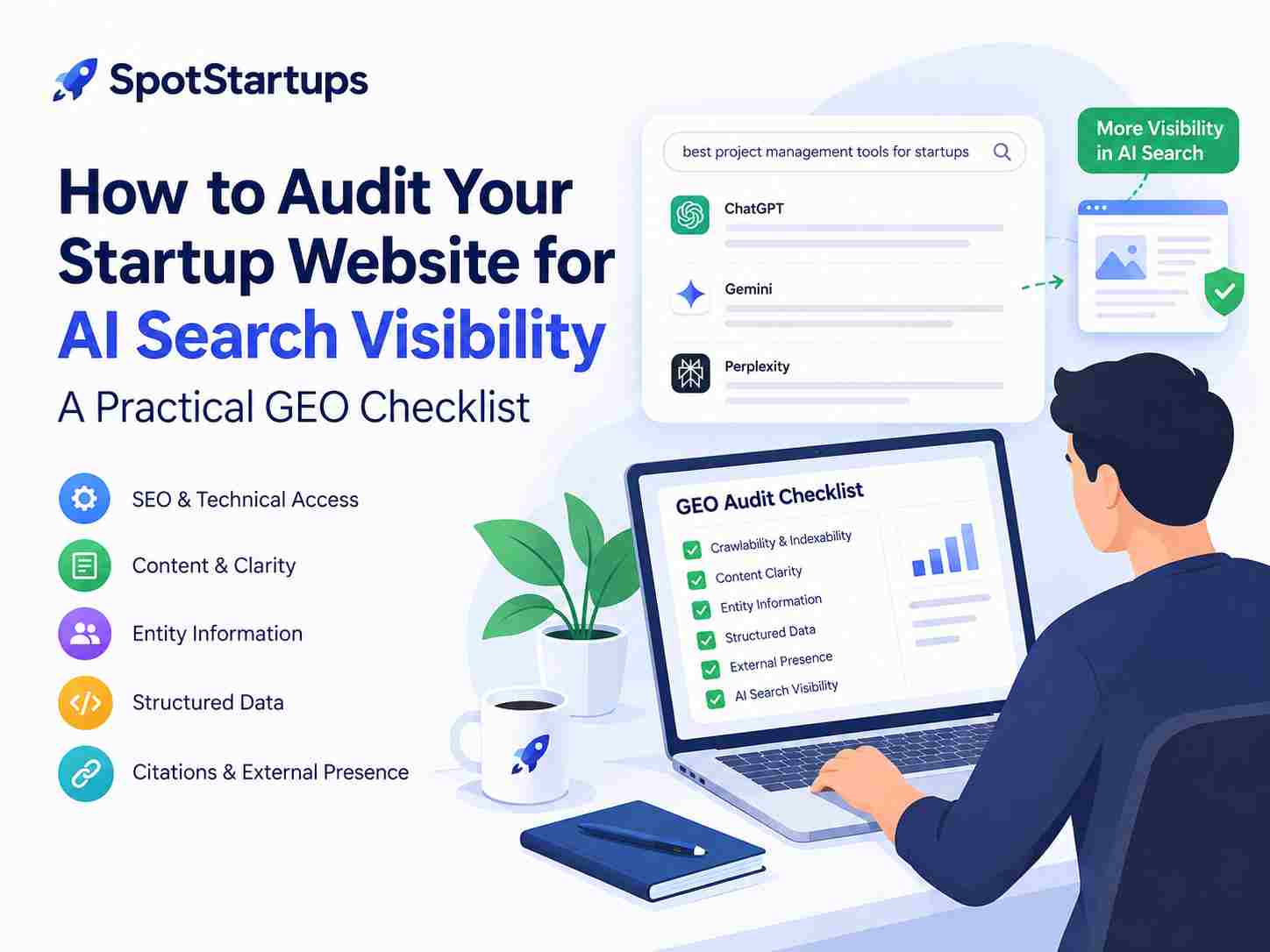
Directory listings can also be part of a broader GEO (Generative Engine Optimization) strategy.
When people research products through AI-powered search experiences, they may encounter information from many different sources across the web.
That makes it useful for a startup to maintain consistent information about:
- What the product does
- Who it is for
- Its main features
- Pricing
- Use cases
- Company name
- Official website
Don't create dozens of low-quality listings simply to generate mentions.
Instead, focus on accurate information on relevant and trustworthy platforms.
Frequently Asked Questions
What are the best startup directories to submit to in 2026?
There are several types of directories to consider, including startup launch platforms, SaaS directories, AI directories and software-review websites. Examples include SpotStartups, Product Hunt, SaaSHub, G2, Capterra, AlternativeTo, Futurepedia, There's An AI For That, BetaList and Uneed.
Where can I submit my SaaS product?
SaaS founders can consider platforms such as SpotStartups, SaaSHub, Product Hunt, G2 and Capterra. The appropriate platform depends on whether the product is newly launched, already has customers, or is being actively evaluated by businesses.
Where can I submit an AI tool?
AI-specific platforms such as Futurepedia and There's An AI For That can be considered alongside broader startup and product directories such as SpotStartups and Product Hunt.
Should I submit my startup to every directory?
No. Start with directories that match your product and target audience. A smaller number of relevant listings can be more useful than submitting your startup indiscriminately to unrelated websites.
Are startup directories free?
Some directories offer free submissions, while others have paid programs, optional promotional services or different requirements for vendors. Always check the current submission terms before submitting.
Is directory submission enough to get startup traffic?
No. A directory listing is only one distribution channel. New startups should combine directory submissions with SEO, content, communities, social media, partnerships, product-led growth and direct customer acquisition.