 Spot Startups

BigideasDB
The first AI platform that scans millions of real user complaints across the web to uncover the SaaS products and startup ideas.

Independent LLM API price desk: compare model pricing across OpenAI, Anthropic, Google and more.
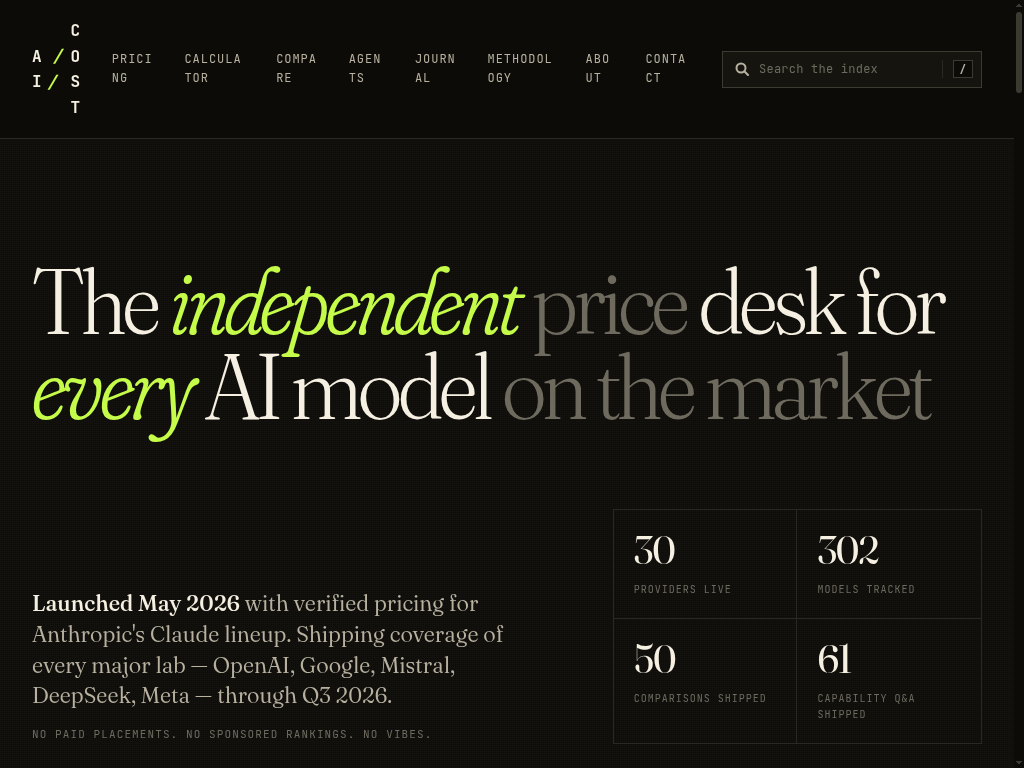
AICost is an independent price desk for AI models, built around one question: what will this actually cost me? It tracks input, output and cache rates per million tokens for 300+ models from 30+ providers, including OpenAI, Anthropic, Google, Mistral, DeepSeek, Qwen and Kimi. Every price is traced to the vendor's own pricing page, dated, kept with its history, and made comparable across APIs, subscriptions and AI coding tools; corrections are published in a public log. Free, embeddable tools include an LLM API cost calculator, token counter, subscription-vs-API calculator and text-to-speech cost calculator, turning your usage into a real monthly bill. Side-by-side model comparisons show the true difference between options, and pricing guides cover AI coding agents such as Claude Code, Codex and Cursor.
Log in to leave a comment.
The first AI platform that scans millions of real user complaints across the web to uncover the SaaS products and startup ideas.

Restaurant Picker App for Group and Solo Dining

Test your APIs in plain English directly from your terminal.

Try a free AI tarot reading: ask one question and draw from 78 original cards to explore what an upright or reversed card brings into focus.


I would suggest you'll use vigiltrism.ai if you're using ai agent so you wont have jailbreak, goodluck!
A change-frequency view would be interesting too. Some providers adjust cache pricing more often than headline rates, and if the correction log already carries dates, that view might be nearly free to build on top of it.
Tracking cache rates separately is the detail that matters. For anyone running agent loops, cached input pricing is where the real bill diverges from the headline number. The public correction log is a strong trust signal. Do you cover embedding models too, or mainly chat and completion models?
i tried and i love this product genuinely
Tracing every price to the vendor's own page with a date and a public correction log is what makes a price comparison usable. Most pricing roundups go stale quietly. One thing I'd find useful: a "price changed in the last 30 days" view per provider, since the surprise cost usually comes from a silent rate or cache-pricing change, not from the headline price. The subscription-vs-API calculator is a good angle too, because that's the choice many small teams are actually stuck on.